*Disclosure: This article is general education, not legal or financial advice. Credit repair can't remove accurate, timely information, results vary by file, and you can dispute errors with the credit bureaus yourself at no cost.*
Having a strong credit profile is an essential part of life in our society. Credit scores are extremely commonplace in all lending institutions and are vital in judging creditworthiness. Depending on the type of credit you are seeking, creditors will use different scoring models to determine your creditworthiness. Each model factors in different elements to judge whether you are a good fit for their credit product. With that said, the following article helps readers understand how these different FICO credit scoring models work, and how to best prepare yourself for each type of loan process!
The majority of American lenders utilize the same-named algorithm developed by The Fair Isaac Corporation (FICO) to determine your credit score when you apply for a loan. Every few years, the business provides lenders with an upgraded version of the algorithm. Since lenders are not obligated to utilize the most recent FICO version, it is crucial to comprehend how the algorithms vary because your score will be affected. We'll go over the most popular iterations of the FICO scoring model in-depth in this guide. We will also discuss some of the changes coming to industries such as mortgage lending with regard to credit scoring.
What Is The FICO 8 and Who Uses It?
The FICO model most frequently used now is FICO 8. Like earlier iterations, it computes your score by factoring in account balances, timely payments, and other aspects of your credit history. Before requesting credit, you should be aware of the key features of the FICO 8 model.
One of the key differences between FICO 8 and earlier versions of FICO is that it is more sensitive to excessive credit line use. To prevent your FICO 8 score from declining owing to high credit use, we advise you to keep your credit utilization at or below 30%.
FICO 8, on the other hand, also brings about improvements for customers. Your FICO score no longer considers accounts in collections with balances of less than $100. Previously, all collections accounts—regardless of how small—were taken into account when calculating your FICO score. Furthermore, when compared to earlier iterations of the FICO model, FICO 8 is more tolerant to singularly late payments of 30 days or more provided that all other accounts are in good standing.
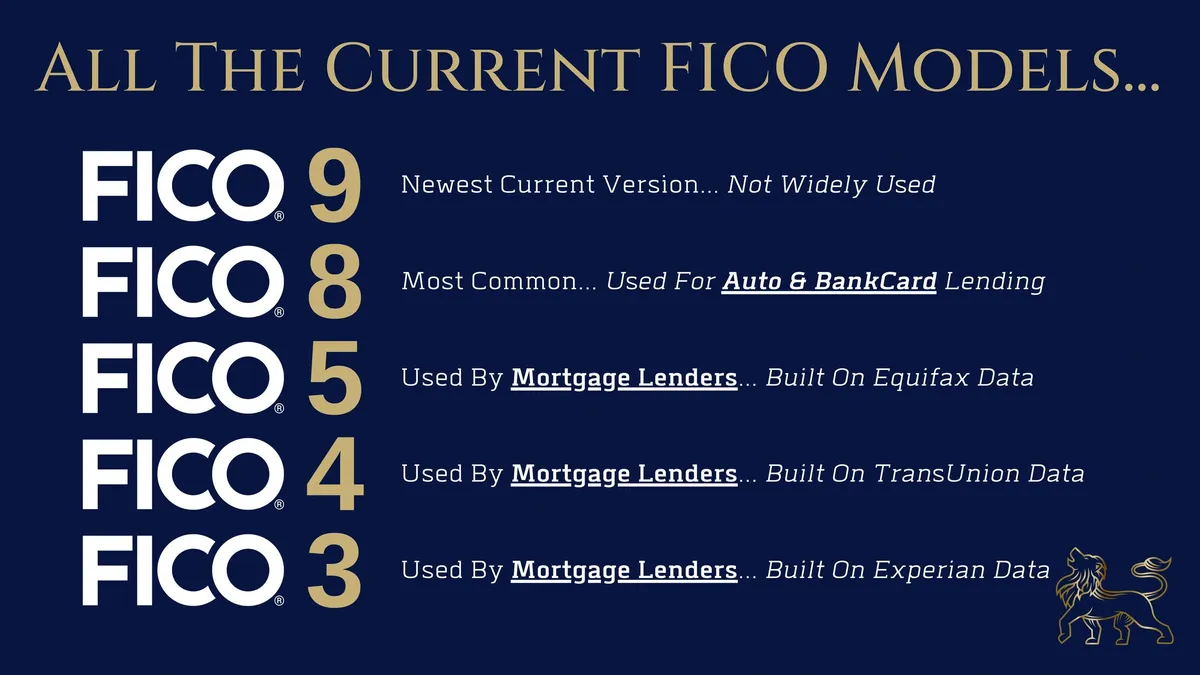
The FICO 8 score has two subtypes: FICO 8 Auto and FICO 8 Bankcard. Lenders utilize FICO 8 Vehicle and FICO 8 Bankcard to determine a borrower's creditworthiness for auto loans and new credit card accounts, respectively.
Similar to the normal FICO 8, these specialty FICO 8 scoring models place more focus on a particular area of your credit history. For instance, FICO 8 Bankcard emphasizes your credit card usage more than FICO 8 Auto. Your FICO 8 Auto and Bankcard scores will be very similar to your conventional FICO 8 score despite these differences.
FICO 8 vs FICO 9: What Are The Key Differences?
When it comes to collections and rent payments, FICO 9 and FICO 8 are different from one another. A surgery bill in collections will have less of an influence on your credit score than a credit card bill in collections because FICO 9 treats medical collections more leniently than other accounts in collections.
Furthermore, accounts in collections with a $0 balance are disregarded by FICO 9. FICO 9 will no longer include the collections account against your score if you had a credit card account that went to collections but later paid it off. Contrary to FICO 8, which considers all collections with a value of $100 or more—regardless of whether they have been fully paid off—into your FICO score.
Lenders may not disregard collections that have a zero balance just because FICO 9 ignores them. These collections will still be listed by credit bureaus on your whole credit report, and lenders will see them when they check your complete credit history.
Last but not least, your credit score in FICO 9 includes your rental history. By making their rent payments on time each month, folks with no credit can more easily establish good credit. Sadly, this depends on your landlord actually reporting rent payments to credit bureaus, which is something that hasn't happened widely yet.
FICO 9 is still relatively new to the market, hence the majority of lenders have not yet adopted it. This will alter over time, so start keeping an eye on your FICO 9 score right away to avoid any unpleasant shocks in the future. On the official credit monitoring program provided by FICO, you can pay a fee to examine your FICO 9 score. Unfortunately, no one is currently providing a free FICO 9 score.
Are The Older FICO Models Still In Use?
There are other versions other than FICO 8 and 9 that are still in use. FICO 2, 4, and 5 are currently used by some lenders and sectors of the economy. In fact, these are still utilized by the mortgage industry to determine interest rates and determine if a borrower is creditworthy of a new mortgage.
FICO 2, 4, and 5 are extremely comparable. The utilization of Experian, TransUnion, and Equifax data in 2, 4, and 5 accordingly represents the main distinction between the three. Each report is obtained by mortgage lenders, who then compile them into a document known as a Residential Mortgage Credit Report. The middle score among the three is chosen to represent your ability to repay the mortgage after duplicate data has been checked and eliminated.
Mortgage lenders may see the history of every account you've opened thanks to the combination of FICO 2, 4, and 5 because FICO 8 and 9 only use information from a single credit agency. Given that many creditors don't submit account histories to all three credit agencies, this is especially beneficial for mortgage lenders.
How Do FICO Scores Differ From Other Credit Scoring Models?
Another well-liked credit scoring model is VantageScore. VantageScore 3.0 analyses credit similarly to FICO, using a scale of 300 to 850 points and factoring in credit use, credit inquiries, and on-time payments. But there is one significant divergence between the two models, among other differences. VantageScore penalizes late mortgage payments more severely than other late payments, but FICO penalizes all late payments equally.
The way that FICO and VantageScore combine related credit queries also differs. With FICO, identical credit queries for student loans, mortgages, and auto loans are bundled into one query for a 45-day grace period. VantageScore only gives you a 14-day grace period, which can make it more difficult to compare loans.
How Will The FICO 10T Credit Scoring Model Affect Future Home Buyers?
In 2020, FICO announced that they would be releasing a new scoring model, which garnered all the attention: the FICO 10T. The main factor that changes with the implementation of the FICO 10T is that it forecasts future credit behavior using historical credit activity going back at least 24 months.
Comparing your current credit score to one being calculated using the FICO 10T scoring model, your score is most likely to decrease if:
- You took out a personal loan to pay off credit card debt, but now your card balances are back up, or it seems like you have applied for more credit.
- You rely on credit cards to get by, yet you can't seem to reduce your balances or they keep rising.
- You have skipped a payment, and under the new FICO scoring methodology, the penalty for being 30 days past due will be significantly harsher.
However, some people may experience a score increase of 20 points or more. If you have been penalized for sporadically having high balances, your score is most likely to go up. As an illustration, Shellenberger said that if you frequently take a vacation in July and charge your airfare, lodging, and meals to a credit card, then pay them off, the trended data won't punish you as harshly. It examines balances over time and notices that you have reduced a balance that was momentarily high.
Best Ways To Keep Your Credit Score High With The FICO 10T?
Here are some of the best ways to keep your score nice and high when applying for a future mortgage with a lender using the FICO 10T scoring model:
- Reduce credit card balances. Rising balances or steadily high statement balances may be an indication of financial difficulties.
- Make multiple payments throughout the month if your account balances are considerable but you are paying down your debts on a monthly basis. No matter when it is reported to the credit bureaus, that maintains your balance low.
- Make every effort not to miss a payment.
- Create an emergency fund if you don't already have one. Your credit scores may suffer if you have to use credit cards in an emergency.
- Avoid charging up the credit card bills again if you are considering settling credit card debt with a personal loan; your FICO 10T score will suffer.
When Do We Think Lenders Will Begin Implementing The FICO 10T?
The three major credit bureaus are now able to use FICO 10 scores. Adoption by lenders, according to Shellenberger, will take time. Months or "often longer for large lenders" are possible wait times.
Currently, the majority of lenders still base their decisions on the 2009-introduced FICO 8 when it comes to non-mortgage lending. FICO scores 2, 4, or 5 are utilised for mortgages. The Federal Housing Finance Agency approved the use of VantageScore 4.0 and FICO 10T by government-sponsored companies Fannie Mae and Freddie Mac in October 2022. The FHFA anticipates that putting these credit score models into practise "will be a multiyear undertaking."
How To Keep Your Credit In Good Shape For Any Loan?
There is no doubt about it: Lenders seek out applicants with good credit. They simply want to reduce the chance that they would approve clients who won't make their payments on time.
The methods for improving credit remain the same:
- Pay all bills promptly.
- Maintain modest credit card balances in comparison to your credit limits to benefit the credit usage scoring component, which has a significant impact.
- Use caution when requesting new credit. A surge in new applications may be a sign of troubled finances.
- If you don't have a strong cause to close an old credit card account, like a large annual charge, keep it open. Their credit limits increase your credit use, and older cards also increase the minor score element known as credit age.
If you have any collection accounts, charge offs, derogatory medical bills, student loans, bankruptcies or other items holding your credit score back, these must be attended to before applying for new credit. You can take care of these issues yourself or hire a credit professional like The Credit Lion, where we have experience with all varieties of credit accounts!